Anti-Stress Solutions for Agriculture: Biostimulants
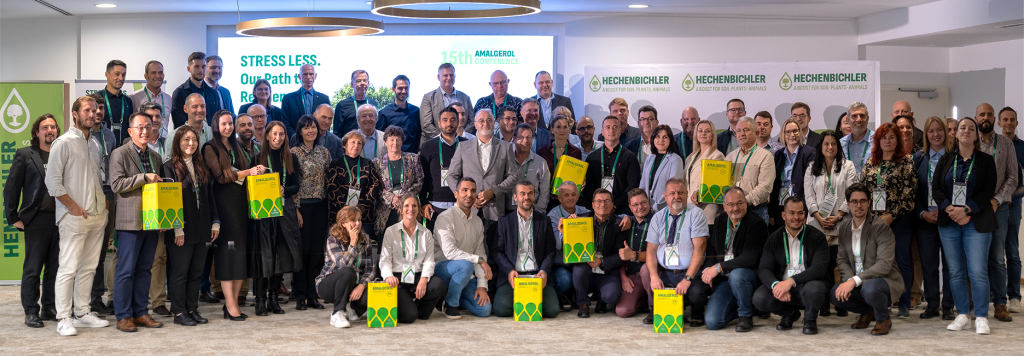
Around 80 participants from more than 20 countries — including Austria, Slovenia, Hungary, Spain and Bulgaria — gathered in Salzburg from 13 to 15 October for the AMALGEROL Conference. Under the theme “STRESS LESS with AMALGEROL”, the event focused on how agriculture can prepare for the challenges posed by drought, heat, extreme rainfall and frost.
“Biostimulants support natural processes within the soil–root–plant system and can improve its resilience to abiotic stress,” explains Hechenbichler Managing Director Hanspeter Hueter. “This is not just about achieving higher yields under favourable conditions, but also about stabilising production under adverse conditions. That makes them a key building block of resilient agriculture.”
Research Highlights Potential for Risk Reduction
This perspective was reinforced by David Barton, representing the European Biostimulants Industry Council (EBIC). In his keynote, he positioned biostimulants as a distinct component of modern crop production alongside seeds, fertilisation and crop protection. Their contribution to reducing stress-related yield losses, he explained, opens up new opportunities for agricultural risk management.
Barton presented an EBIC analysis covering multiple products across 114 trials involving 20 crops. In the field trials conducted under abiotic stress, treated plants yielded an average of 19.7% more than untreated controls. Across the analysis as a whole, the relative benefit increased with the severity of stress. The findings highlight the potential of different biostimulants under the conditions studied; they do not constitute a general yield promise for individual products.
Barton also stressed the importance of verifiable evidence of efficacy. He noted that European regulation, common testing standards and CE marking had established a foundation for trust and market access. Building on this, he highlighted the need to explore how demonstrated resilience benefits could also be recognised in agricultural support schemes, insurance and financing models.
International Trials with AMALGEROL
Research presentations and reports from the field illustrated concrete applications: A 2026 strawberry field trial conducted by the University of Maribor and presented at the conference documented a yield increase of around 33% following six applications of AMALGEROL ESSENCE. Further presentations addressed the combined use of AMALGEROL and foliar fertilisation in winter wheat in Hungary, soil quality in barley fields irrigated with saline water in Spain, and crop-specific experience from Bulgaria. The studies reflect a range of site and growing conditions and provide a basis for further refining application practices.
Specialised Applications for Targeted Support
Silvia Fluch, Head of Research and Development at Hechenbichler, outlined how the range of applications is evolving. She explained that, building on years of field experience, the company is increasingly complementing proven products such as AMALGEROL and AMALGEROL ESSENCE with targeted formulations based on a deeper understanding of their modes of action. Preventive application, before stress takes its full effect, remains essential.
Hechenbichler presented AMALGEROL SUN and AMALGEROL SEED as specialised applications reflecting this approach. AMALGEROL SUN supports plants exposed to heat and intense sunlight and UV radiation. AMALGEROL SEED is applied as a seed treatment and promotes germination, early growth and root development. This allows support to be targeted to specific stress factors and growth stages.
Biostimulants as a Success Factor for the Future of Agriculture
For Hechenbichler, the role of biostimulants is undergoing a fundamental shift: from an add-on product for higher yields under favourable conditions to a strategic success factor in the face of increasing climate stress. “The key question is no longer just how much we invest in agricultural production. It is how much the system can achieve with the limited resources available to it,” explains Hueter. “We cannot irrigate more when no water is available. And we cannot assume that fertilisers will always be available at predictable prices.”
Biostimulants do not replace water or fertilisers. They can, however, help make more efficient use of both. As FMC reported at the conference, good results with biostimulants were also achieved in Spain using lower-quality irrigation water. Their value therefore lies not only in an additional benefit at the end of the season, but in improving the conditions for successful production. Through the interplay of soil activity, root development and plant stress responses, they support the performance of the entire soil–root–plant system. Early preparation is crucial. “You do not start building endurance during a marathon. Likewise, we need to build resilience in agriculture before stress becomes critical,” says Hueter. “That is why we believe AMALGEROL belongs in crop planning—not as a last resort once damage is already visible, but as a planned component of the production strategy.”
Greater Recognition for Prevention in Agricultural Support
This also underpins Hueter’s call to policymakers: “If biostimulants demonstrably contribute to more efficient resource use and help keep agriculture productive under more challenging conditions, this should be better reflected in agricultural support programmes. Early preparation is in the public interest — its costs must not be borne by farmers alone.”
Hueter concludes: “Biostimulants are about enabling agricultural success and reliable food production even under less predictable climatic conditions. We cannot change the weather forecast. But we can influence how well agriculture is prepared for it.”